Mudras are symbolic hand gestures or postures that are often used in Hinduism, Buddhism, and other Indian spiritual practices. These gestures are believed to have specific meanings and effects on the body’s energy flow, emotions, and consciousness. Mudras are commonly used during meditation, yoga, and ritualistic practices to enhance concentration, promote healing, and facilitate spiritual growth.
In Indian traditions, the human body is considered to be a microcosm of the universe, with the fingers representing different elements, energies, and qualities. By arranging the fingers in specific configurations, practitioners can supposedly tap into and manipulate these energies for various purposes. Mudras are typically performed by using the fingers of one or both hands, but they can also involve other body parts, such as the eyes, tongue, and whole body postures.
Mudras play a role in enhancing concentration, fostering healing, and facilitating spiritual development. Practitioners use these gestures to harness and manipulate subtle energies for various purposes, with each mudra having distinct significance and potential benefits. While deeply rooted in cultural and spiritual traditions, their effectiveness is often based on belief and anecdotal evidence, rather than scientific validation. Therefore, it’s advisable to learn and practice mudras under the guidance of experienced practitioners or knowledgeable teachers, especially if you’re new to these practices.

There are numerous mudras, each with its own significance and benefits. Some mudras are associated with balancing the body’s elements, while others are focused on stimulating particular energy pathways in the body.
Few Mudras as follows :
Adi Mudra
Anjali Mudra
Abhaya Mudra
Apana Mudra
Agni Mudra
Akash Mudra
Brahma mudra
Chin (Gnana) Mudra
Chinmaya Mudra
Dyana Mudra
Ganesha Mudra
Prana Mudra
Prithvi Mudra
Surya Mudra
Shoonya
Varuna Mudra
Vayu Mudra
Jalashaya Mudra
Adi Mudra:
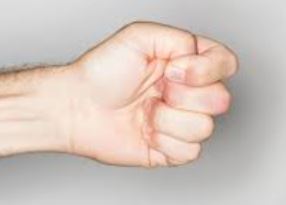
Adi mudra is considered the first mudra because it is the first position an infant can make with the hands. It is often used while practicing meditation, and is thought to aid in pranayama because it increases breathing and lung capacity, thus increasing oxygen flow throughout the body
The Adi Mudra activates all the elements (i.e earth , water, fire, air and ether) within the body. Clasp the thumb with all the four fingers of both hands, relax your breath. Simply relax your breath and then release the thumb, again do this.
It might have many several effects which include relaxation of the nervous system, snoring reduction, increase in blood circulation to the brain, and capacity of the lung. Adi Mudra locks and guides energy flow and reflexes to the brain.
It might have many several effects which include relaxation of the nervous system, snoring reduction, increase in blood circulation to the brain, and capacity of the lung. Adi Mudra locks and guides energy flow and reflexes to the brain
Anjali Mudra (Prayer Gesture):

Anjali Mudra is a common mudra performed by bringing the palms together in front of the chest in a prayer-like position. It represents unity, respect, and humility.
Namaste, two hands folded in a welcome greeting, is the salutation that Indians are globally welcomed with. Literal meaning – ‘I salute the divinity in you’
The coming together of both hemispheres of our brain when we do the Anjali Mudra channelizes our thought process temporarily. You can feel your mind experiencing positive thoughts during the practice.
Slow breathing during the process of Anjali Mudra and its connection to the heart improves the circulation of oxygen in the blood. It also balances the breathing pattern, calming an agitated mind instantly.
At the midpoint of our brain hemispheres lies the pituitary gland, which is considered the seat of intuition. Bringing your hands together not only balances the working of the adrenal and pituitary glands, but it also gives a jolt to your intuitive capabilities.
Bringing together of brain hemispheres improves their coordination and functioning.
Practicing Anjali Mudra regularly brings more awareness, enhances concentration, and calms the mind thereby relieving stress.
Physically it improves flexibility of the arm joints and wrists.
Aside from stimulating the Anahata chakra , the regular practice of Anjali Mudra is seen to stimulate the Ajna chakra as well. Anahata Chakra is located in the center of our chest and it’s stimulation helps us deal with our emotions in a better way. Ajna Chakra is located in the middle of the eyebrows and is the concentration center of our body. Stimulating it increases our focus and memory prowess.
Apana Mudra (Energy Gesture):

Apana Mudra involves touching the tip of the thumb to the tip of the middle and ring fingers, while the other fingers are extended. It is said to help with detoxification and balancing the body’s energies
Apana Mudra is believed that practicing a mudra properly may help in awakening the Goddess sleeping at the door of Lord Brahma, the creator of the universe. Mudras are believed to be the key to good health.
Apana mudra is known to balance the root chakra and awaken the energy which helps us live our lives.
In Hindu rituals, Apana mudra is also a way of offering ‘naivedyam’ (during worship to God).
Apana mudra is also known as the purification mudra, as its regular practice regulates excretion and urination well.
Strengthening the immune system.
Abhaya Mudra :

The Abhaya Mudra “gesture of fearlessness” represents protection, peace, benevolence and the dispelling of fear. In Theravada Buddhism it is usually made while standing with the right arm bent and raised to shoulder height, the palm facing forward, the fingers closed, pointing upright and the left hand resting by the side.
This mudra, often used in blessings, signifies the transmission of healing vibrations.The Abhaya Mudra primarily activates the third eye chakra, associated with wisdom and healing.
This gesture is used to dispel fear and develop courage, highlighted by the name abhaya which is Sanskrit for “fearlessness.” Abhaya mudra is symbolic of safety, protection, peace and reassurance, and can be called upon during challenging times
Bhrama Mudra:
Brahma mudra is said to be mentioned in the ancient literature of Rigveda. In Sanskrit, the term brahma means divine or sacred and mudras define gestures for the hand, head and eyes
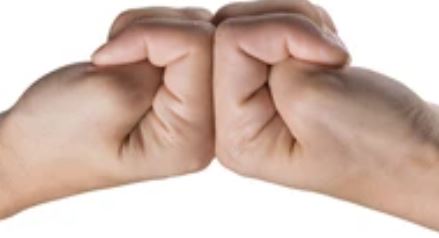
To perform Brahma Mudra:
Sit in a comfortable meditation posture with your spine straight.
Keep your hands on your thighs with your palms facing up.
Fold your thumbs inward so that they touch the base of their respective little fingers.
Wrap your other fingers over and around the thumbs to make fists.
Bring the knuckles of both fists opposing each other.
Gently press the knuckles against each other.
Rest your hands gently against the pubic bone, which is the area just below your navel.
Brahma mudra finds its potential benefits in the management of neck pain, blood pressure, diabetes and hypertension.
In Brahma Mudra, the practitioner moves the head in all 4 directions while producing the “Beeja” sounds (seed sounds) with exhalation. The 4 seed sounds are aaa, uuu, eee, and mmm which when combined together make the vibration of OM, the sound of the universe.
Brahma Mudra is believed to have several benefits, including:
Balancing Energy: This mudra is thought to balance the body’s energy and harmonize the flow of prana (life force).
Stimulating Muladhara Chakra: The positioning of the hands in Brahma Mudra is associated with the Muladhara chakra, which is the root chakra. Stimulating this chakra is believed to enhance feelings of stability and groundedness.
Mental Clarity: Practicing Brahma Mudra can help calm the mind, reduce stress, and improve concentration.
Enhancing Digestion: Some practitioners believe that this mudra can aid in digestion and alleviate digestive issues.
Spiritual Connection: Like many mudras, Brahma Mudra is also associated with enhancing one’s spiritual connection and inner awareness.
It’s important to note that the effectiveness of mudras can vary from person to person, and their benefits are often based on traditional beliefs and anecdotal evidence rather than scientific research.
Chin Mudra (Consciousness Gesture):
To perform Chin Mudra , the index finger is placed at the root of the thumb, with the other fingers extended. It is thought to promote focus and deepen meditation.

It is thought to promote focus and deepen meditation,Better retention and concentration power,Improves sleep pattern,Increases energy in the body,Alleviates lower backache.
The mudra represents spiritual enlightenment in the religions. Sometimes sadhus chose to be buried alive in this samadhi position. A 2700 old skeleton arranged like this was found at Balathal in Rajasthan, suggesting that something like yoga may have existed at that time. It is believed to enhance concentration, memory, and knowledge,Harmonizes the Nervous System.
Supports Pranayama Practices: This mudra is often used during pranayama exercises to regulate and control the breath. It can help redirect the flow of prana (life force energy) within the body.
It is believed that the practice of chin mudra may instill wisdom and spiritual enlightenment in an individual. Chin mudra may help to boost the immune system, regulate blood pressure, improve concentration and manage stress and depression. It may also protect against cancer and help in the case of insomnia.
Chinmaya Mudra:

In the Chinmaya Mudra, the thumb and forefinger form a ring, and the three remaining fingers are curled into the palms of the hands. Again, the hands are placed on the thighs with palms facing upwards, and deep comfortable Ujjayi(Deep) breaths are taken. Once more, observe the flow of breath and its effect.
Chinmaya Mudra is Sanskrit word which means “supreme awareness” , ” pure wisdom”. Improves the flow of energy in the body. Stimulates digestion.
It opens up the middle lobes of your lungs and aids absorption of food. Reduces stress and head aches, effective for back pain

Dhyana Mudra:
The Dhyana mudra is the gesture of meditation, of the concentration of the Good Law and the sangha. The two hands are placed on the lap, right hand on left with fingers fully stretched (four fingers resting on each other and the thumbs facing upwards towards one another diagonally), palms facing upwards; in this manner, the hands and fingers form the shape of a triangle, which is symbolic of the spiritual fire or the Three Jewels. This mudra is used in representations of Gautama Buddha and Amitabha.
Sometimes the dhyāna mudrā is used in certain representations of Bhaiṣajyaguru as the “Medicine Buddha”, with a medicine bowl placed on the hands. It is heavily used in Southeast Asia in Theravada Buddhism; however, the thumbs are placed against the palms. Dhyāna mudrā is also known as “samādhi mudrā” or “yoga mudrā”.
Gnyana Mudra (Knowledge or Wisdom ): Gnyana is done by touching the tips of the thumb and the index together, forming a circle, and the hand is held with the palm inward towards the heart. The mudra represents spiritual enlightenment in the religions. Sometimes sadhus chose to be buried alive in this samadhi position. A 2700 old skeleton arranged like this was found at Balathal in Rajasthan, suggesting that something like yoga may have existed at that time. It is believed to enhance concentration, memory, and knowledge
Karana Mudra:
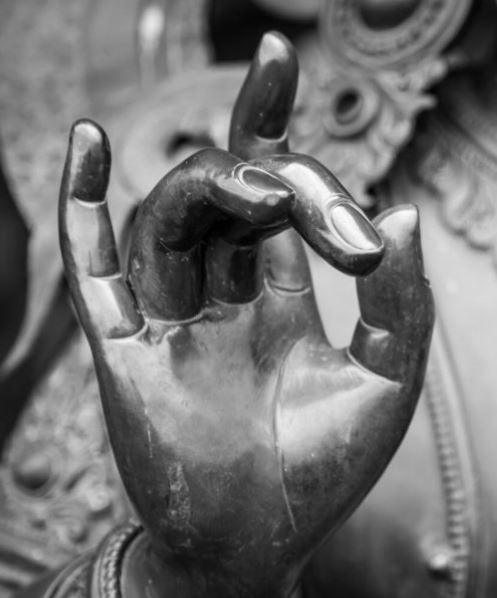
The karana mudrā is the mudra which expels demons and removes obstacles such as sickness or negative thoughts. It is made by raising the index and the little finger, and folding the other fingers. The difference is that in the Karana mudra the thumb does not hold down the middle and ring finger.
Shoonya Mudra (Emptiness Gesture):

This mudra involves placing the tip of the thumb against the base of the middle finger, while the other fingers are extended. It is believed to alleviate ear and throat-related issues.
Shoonya Mudra (Emptiness Gesture): This mudra involves placing the tip of the thumb against the base of the middle finger, while the other fingers are extended. It is believed to alleviate ear and throat-related issues.
Common Yoga Protocol Book-English Published y the Ministry of Ayush Government Of India –https://yoga.ayush.gov.in/api/uploads/assets/cyp/Common%20Yoga%20Protocol%20Book-English.pdf
https://www.vedpuran.com/hasta_mudras.asp
https://isha.sadhguru.org/yoga/yoga-articles-yoga/mudras-science-types/
 Swayam Samrudhi